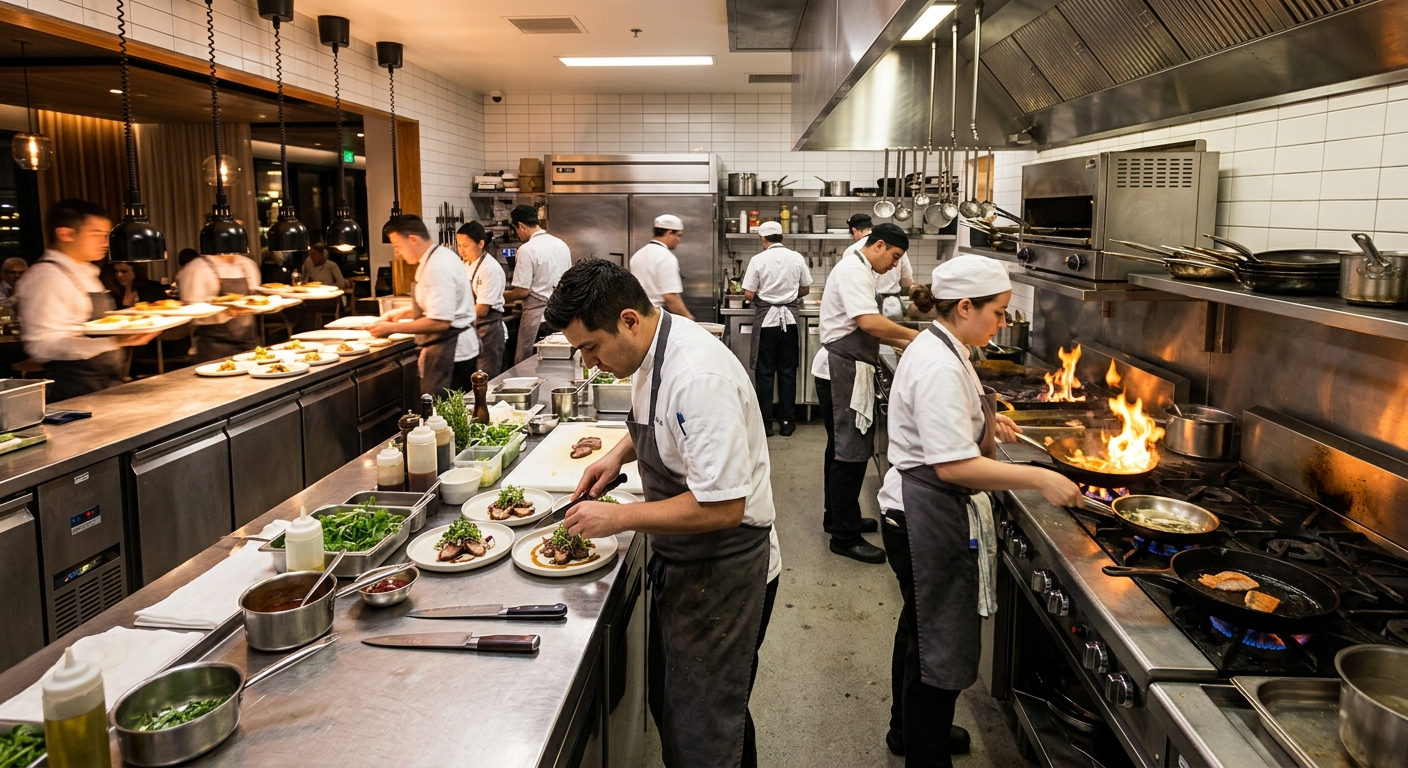
Selling to restaurants is one of the hardest B2B sales environments. Owners work long hours, screen every call, and have thin margins that make them resistant to new vendors. Food suppliers, kitchen equipment dealers, POS system vendors, and restaurant service providers all struggle to reach decision-makers who control purchasing.
Purchased restaurant lists are outdated the moment you buy them. Staff turnover in restaurants is 75% annually, meaning contact lists decay faster than almost any other industry. National databases include chains that make decisions at corporate headquarters, not individual locations. You waste time calling managers who cannot buy and locations that are not real prospects.
Google Maps offers a better path. It contains virtually every restaurant, cafe, bar, and food service business with current phone numbers, websites, and operational data. You can identify independent restaurants versus chains, new openings versus established businesses, and specific cuisine types that match your product. You can extract owner contact information and build a prospect list that reflects the actual restaurant landscape in your territory.
This article shows you how to find restaurant leads for food suppliers and kitchen equipment sales using Google Maps data. You will identify qualified prospects, extract accurate contact details, and build outreach campaigns that reach owners and chefs directly. The cost is $79 one time. No list rental fees. No per-contact charges.
Why traditional restaurant lead generation fails
Restaurant prospecting has unique challenges that most sales approaches do not address:
Problem 1: Extreme contact decay
Restaurant manager turnover is the highest of any industry. A contact list from six months ago is already 40% obsolete. Chefs move between restaurants. Owners sell or close. General managers change quarterly.
Problem 2: Corporate vs. local purchasing confusion
Chain restaurants (McDonald’s, Applebee’s, Olive Garden) make equipment and supply decisions at corporate headquarters. Calling individual locations wastes everyone’s time. You need to identify independent restaurants where the owner makes local decisions.
Problem 3: Gatekeeper intensity
Restaurant owners and chefs are flooded with vendor calls during service hours. Cold calling between 11 AM and 2 PM is pointless. You need email addresses and off-hours contact methods.
Problem 4: Mismatch between product and prospect
A bakery has different equipment needs than a steakhouse. A food truck needs different supplies than a hotel restaurant. Generic lists do not segment by cuisine type, service style, or kitchen setup.
What Google Maps offers restaurant sales professionals
Google Maps contains rich restaurant data that makes prospecting precise:
Cuisine type and service style:
Search queries reveal specific restaurant categories: Italian, Mexican, sushi, bakery, BBQ, vegan, fine dining, fast casual, food trucks. Each category has different equipment needs, ingredient suppliers, and service requirements.
Ownership structure indicators:
Independent restaurants typically have the owner’s name in the business listing or website. Chains have corporate branding and standardized names. Review responses often reveal whether the owner is personally engaged.
Operational signals:
Hours, review volume, photos, and menu mentions reveal business health and scale. A restaurant with 300 recent reviews and full hours is busy and profitable. A restaurant with 5 old reviews and limited hours is struggling.
Current verified contact data:
Active restaurants maintain current phone numbers and websites. MapGopher visits websites to extract additional emails and contact details that Maps does not display.
Finding restaurant prospects on Google Maps
The search strategy targets specific restaurant types based on what you sell.
Search queries by restaurant type
| Search Query | Restaurant Type | Typical Equipment/Supply Needs |
|---|---|---|
| ”Italian restaurant [city]“ | Full-service Italian | Pasta machines, pizza ovens, wine storage |
| ”sushi restaurant [city]“ | Japanese/sushi | Rice cookers, display cases, fish suppliers |
| ”BBQ restaurant [city]“ | Barbecue | Smokers, wood suppliers, ventilation |
| ”bakery [city]“ | Bakery/pastry | Mixers, ovens, display cases, packaging |
| ”coffee shop [city]“ | Coffee/cafe | Espresso machines, grinders, bean suppliers |
| ”food truck [city]“ | Mobile food | Compact equipment, generator, commissary |
| ”steakhouse [city]“ | Fine dining steak | Broilers, dry aging, premium suppliers |
| ”vegan restaurant [city]“ | Plant-based | Specialty ingredients, prep equipment |
| ”seafood restaurant [city]“ | Seafood | Display cases, ice machines, fresh suppliers |
| ”pizza restaurant [city]“ | Pizza | Deck ovens, dough equipment, delivery supplies |
| ”Chinese restaurant [city]“ | Chinese/Asian | Woks, steamers, rice cookers, specialty items |
| ”catering company [city]“ | Catering | Transport equipment, chafing dishes, large batch |
Search queries by business model
| Search Query | Business Type | Sales Opportunity |
|---|---|---|
| ”ghost kitchen [city]“ | Delivery-only | Compact equipment, packaging, delivery tech |
| ”brewery [city]“ | Craft beer | Taps, kegs, brewing equipment, food pairing |
| ”winery [city]“ | Wine production | Tasting room supplies, preservation, glassware |
| ”hotel restaurant [city]“ | Hospitality | High-volume equipment, room service supplies |
| ”golf course restaurant [city]“ | Recreation | Event equipment, banquet supplies |
| ”banquet hall [city]“ | Event venue | Large-scale kitchen, serving equipment, rentals |
Identifying independent vs. chain restaurants
Your sales approach depends entirely on ownership structure:
Independent restaurants (target these):
- Business name includes owner name or local reference
- Website is independent with unique branding
- Owner responds to reviews personally
- Single location
- Unique menu items and descriptions
Chain restaurants (avoid for local sales):
- National brand names (Subway, Denny’s, Chili’s)
- Corporate websites with location finders
- Standardized menus and branding
- Multiple locations in region
- Corporate social media accounts
Regional chains (evaluate individually):
Some regional chains (5-20 locations) make local decisions for certain purchases. Research the specific chain to understand their purchasing structure.
Building your restaurant prospect database
Organize extracted data for targeted outreach and account management.
Essential data fields
| Field | Purpose | How to Use It |
|---|---|---|
| Restaurant name | Identification | Reference in outreach |
| Owner/chef name | Personalization | Address decision-maker directly |
| Phone number | Direct contact | Call during off-peak hours |
| Email address | Campaigns | Send catalogs, proposals, samples |
| Website | Research | Identify current equipment and menu |
| Cuisine type | Messaging | Tailor pitch to kitchen setup |
| Address | Territory | Plan efficient sales routes |
| Review count/volume | Health indicator | Prioritize busy, growing restaurants |
| Hours | Call timing | Contact before lunch or after dinner |
Segmenting by sales opportunity
Create categories for targeted campaigns:
By kitchen equipment need:
- Oven and cooking equipment (pizza ovens, combi ovens, ranges)
- Refrigeration (walk-ins, reach-ins, display cases)
- Food prep (mixers, slicers, processors)
- Dishwashing (commercial dish machines, sinks)
- Ventilation (hoods, exhaust, make-up air)
- Smallwares (pots, pans, utensils, storage)
By supply category:
- Food ingredients (produce, protein, specialty items)
- Beverage (coffee, beer, wine, soda)
- Packaging (takeout containers, bags, labels)
- Paper goods (napkins, towels, toilet paper)
- Chemicals (cleaning, sanitizing, dish soap)
By restaurant lifecycle:
- New openings (0-6 months): Need everything, tight budgets, high urgency
- Growth phase (6 months-3 years): Adding capacity, upgrading equipment
- Established (3-10 years): Replacement cycles, efficiency upgrades
- Renovation candidates (10+ years): Full kitchen overhauls
The restaurant sales outreach script
Restaurant owners and chefs are bombarded with vendor pitches. Your approach must be concise, respectful of their time, and immediately relevant to their operation.
The initial email
Subject: Quick question about [Restaurant name]
Hi [Owner/Chef name],
I am [Your name] with [Company]. We provide [equipment/supplies/services] for [cuisine type] restaurants in [city].
I came across [Restaurant name] and wanted to reach out because [specific observation: recent opening, expansion, menu focus, equipment need]. We recently helped [similar restaurant] with [specific outcome].
I know you are busy, especially during service. Would you be open to a brief 5-minute call before service or during your afternoon break?
Best, [Your name] [Company] [Phone]
The phone call
“Hi [Name], this is [Your name] with [Company]. I sent you an email about [specific product/service]. I promise to keep this under two minutes. We help [cuisine type] restaurants with [specific outcome]. Do you have a quick second, or should I call back at a better time?”
Best calling times:
- 9:00-10:30 AM (before lunch prep)
- 2:30-4:30 PM (post-lunch, pre-dinner)
- After 9:00 PM (fine dining, after service)
- Monday or Tuesday (slowest days for most restaurants)
The new restaurant opening approach
New restaurants need everything and have tight timelines:
“Hi [Name], congratulations on [Restaurant name]. I saw you are opening soon. We specialize in [equipment/supplies] for [cuisine type] restaurants and have helped several openings in [city] get fully equipped on schedule. Opening delays are expensive. Would it make sense to get a quote for [specific items] so you have a backup option?”
Kitchen equipment sales strategies
Equipment sales require technical knowledge and trust-building.
The equipment assessment offer
Offer a free kitchen assessment that identifies bottlenecks and opportunities:
“We offer complimentary kitchen workflow assessments for restaurants in [city]. We identify where your current setup creates delays, waste, or safety issues. There is no obligation. Most owners learn something useful even if they do not buy from us. Would you be open to a 20-minute walk-through?”
Trade-in and upgrade programs
Position replacements as upgrades:
“Many restaurants your size are upgrading from [old equipment type] to [new equipment type] because [specific benefit: energy savings, speed, consistency]. We offer trade-in credits and installation included. Would you like to see what the upgrade would look like for your kitchen?”
Financing for equipment
Restaurant cash flow is tight. Offer financing:
“We partner with equipment financing companies that offer $1 buyout leases with no money down. Your monthly payment is often less than the energy savings from the new equipment. Would you like to see the numbers?”
Food supplier prospecting
Food suppliers face intense competition. Differentiation comes from product knowledge and reliability.
The specialty ingredient approach
Lead with unique products:
“Hi [Chef name], I am [Your name] with [Company]. We import [specialty ingredient] that I think would work well with your [specific menu item]. Several [cuisine type] chefs in [city] have added it to their menus. I would be happy to send a sample with some preparation suggestions. Would that be of interest?”
The local sourcing angle
Many restaurants market local sourcing:
“We work with farms within 50 miles of [city] to supply restaurants with [produce/protein/dairy] that is harvested and delivered within 48 hours. If local sourcing is part of your menu story, I would love to connect you with our growers.”
Real-world example: Restaurant equipment sales rep
A kitchen equipment dealer in Atlanta used this system to build a restaurant prospect pipeline.
Month 1: Extracted 600 restaurants across metro Atlanta, segmented by cuisine type and filtered out national chains
Month 2: Sent targeted campaigns: pizza oven promotions to pizzerias, espresso machine promotions to coffee shops, combi oven promotions to fine dining
Month 3: Followed up with calls during off-peak hours, scheduled 12 kitchen assessments
Results after 6 months:
- 9 equipment sales ($85,000 total)
- 4 supply contracts with monthly recurring orders
- 3 new opening packages ($45,000 total)
- Pipeline of 40 qualified prospects
Total cost to build the list: $79 for the scraper and 30 hours of outreach.
Common mistakes in restaurant sales
Mistake 1: Calling during service hours
Nothing annoys a chef or owner more than a sales call during lunch rush. Call before 10 AM or after 2:30 PM.
Mistake 2: Generic product pitches
A sushi restaurant does not need a pasta machine. Segment your list by cuisine type and customize every message.
Mistake 3: Ignoring new openings
New restaurants need everything. Monitor Google Maps for new listings, construction, and “opening soon” indicators. These are the highest-value prospects.
Mistake 4: Competing only on price
Restaurant owners value reliability, quality, and service over the cheapest option. A vendor who delivers on time every time is worth more than a 10% discount.
Mistake 5: Giving up after one touch
Restaurant owners are busy, not uninterested. A chef who ignores your first email may become your best customer after the third follow-up. Persistence wins.
Getting started today
If you sell to restaurants and need a better prospecting system, here is your action plan:
-
Extract restaurant data from Google Maps. Segment by cuisine type and filter out corporate chains.
-
Research each prospect’s website and menu. Identify equipment needs and current suppliers.
-
Build cuisine-specific lists. Create segments for Italian, sushi, BBQ, bakery, and other categories.
-
Send personalized outreach. Reference specific menu items, recent openings, or local observations.
-
Call during off-peak hours. Respect service schedules.
-
Follow up consistently. Restaurant sales cycles are short for urgent needs, long for equipment. Match your follow-up to the opportunity.
Within 60 days, you can build a restaurant prospect database that outperforms any purchased list.
The bottom line
Restaurants are high-volume buyers of equipment, supplies, and services. Google Maps contains current data for virtually every restaurant in your territory, updated by the businesses themselves.
For a one-time investment of $79, you can extract unlimited restaurant leads, build cuisine-specific prospect lists, and reach owners and chefs directly without paying list rental fees or competing with every vendor who bought the same database.
Stop buying outdated restaurant lists. Start building your own targeted prospect database with current contact data that reflects the actual restaurant landscape in your market.
MapGopher extracts unlimited Google Maps leads with automatic email discovery for a one-time $79 purchase. Build your restaurant supplier prospect list without monthly fees or per-contact charges.