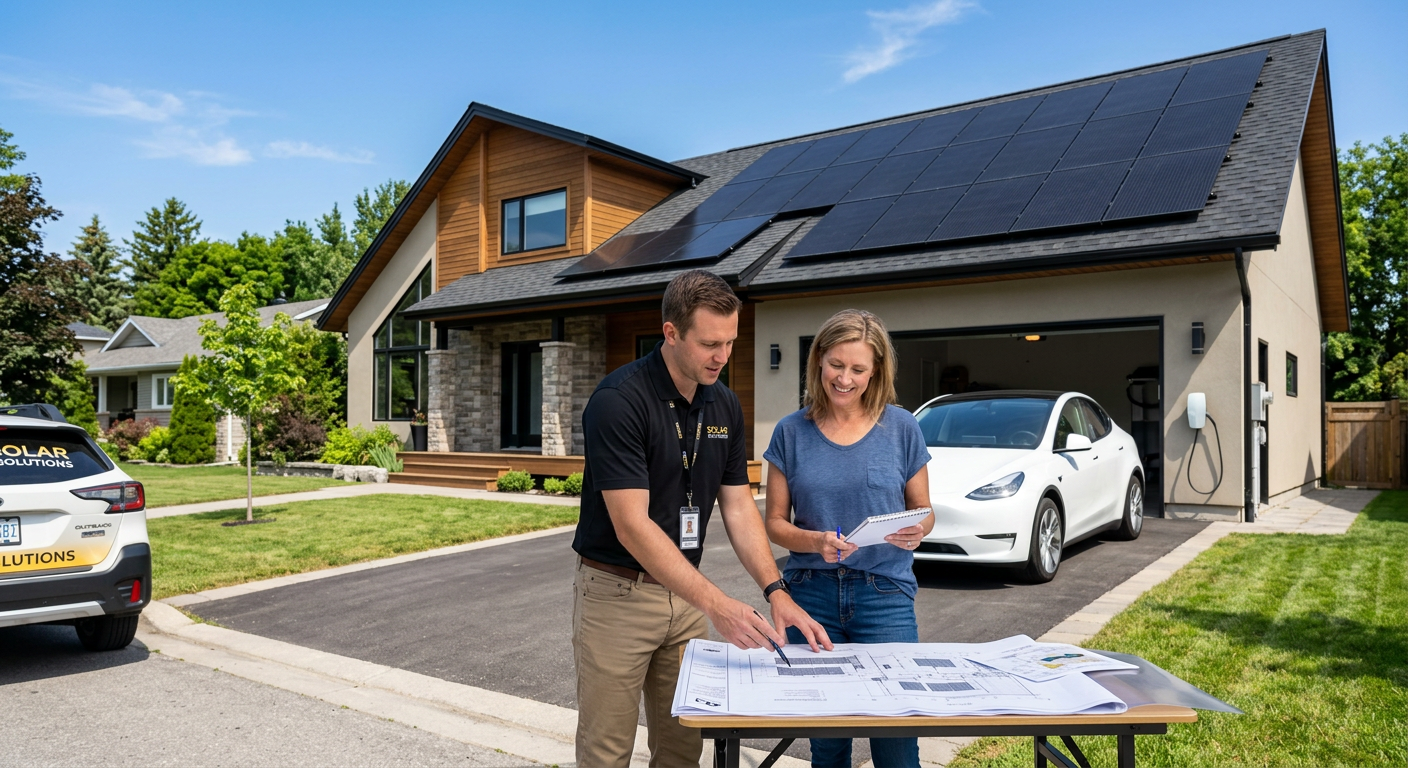
Door-to-door solar sales is brutal. You walk neighborhoods in extreme weather, deal with constant rejection, and hope to catch homeowners at the right moment. The burnout rate is high, and the ROI is unpredictable. Yet most solar companies still rely on canvassing as their primary lead source.
There is a better way. Google Maps contains every home and business in your territory with satellite imagery that reveals roof conditions, property characteristics, and solar potential. You can identify ideal prospects from your computer, get their contact information, and reach out with targeted offers. No walking. No rejection at the door. No weather dependence.
This article shows you how to generate solar leads using Google Maps data. You will identify properties with high solar potential, extract owner contact information, and build a pipeline of qualified prospects who actually want to talk about solar. The cost is $79 one time. No lead fees. No territory restrictions.
Why door-to-door solar sales is broken
Door-to-door canvassing has fundamental problems that make scaling difficult:
Problem 1: Low contact rates
Most homeowners are not home during canvassing hours. You walk past hundreds of houses to speak to a handful of people. The efficiency is terrible.
Problem 2: Immediate rejection
Even interested homeowners reflexively say “not interested” to strangers at the door. You are fighting human nature, not product objections.
Problem 3: Weather dependent
Rain, snow, and extreme heat shut down canvassing operations. Your lead flow stops when the weather turns.
Problem 4: High turnover
Canvassing jobs have 80%+ annual turnover. Constantly training new reps burns time and money.
Problem 5: Limited targeting
You walk every house in a neighborhood, whether they are good solar candidates or not. Wasted steps on renters, shaded properties, and recent installations.
Data-driven prospecting solves these problems. You contact the right people through the right channels with the right message.
What makes a qualified solar prospect
Not every property is a good solar candidate. You want prospects with specific characteristics that indicate high conversion potential.
High-priority residential targets:
- Single-family homes with large, unshaded roofs
- Homes with south-facing roof planes (visible on satellite)
- Properties with high electricity bills (large homes, pools, electric vehicles)
- Newer roofs (less than 15 years old, visible condition)
- Homes in high solar adoption neighborhoods
- Owner-occupied properties (not rentals)
High-priority commercial targets:
- Warehouses with large flat roofs
- Manufacturing facilities with high energy usage
- Retail centers with extensive roof space
- Schools and municipal buildings (public sector sales)
- Agricultural operations (farms, dairies, processing facilities)
- Car dealerships (large buildings, high visibility)
Qualifying indicators from Google Maps:
- Clear satellite view of roof (no heavy tree cover)
- Large roof area relative to home size
- South or west-facing orientation
- No visible solar panels already installed
- Pool or spa (indicates higher electricity usage)
- Electric vehicle in driveway (visible in street view)
- Recent construction or roof replacement
Finding solar prospects on Google Maps
The search strategy targets property types and locations with high solar potential. You want owners with the right roof conditions and energy needs.
Search queries for residential solar
| Search Query | Prospect Type | Solar Potential |
|---|---|---|
| ”swimming pool service [city]“ | Pool owners (high electric bills) | High |
| ”electric vehicle charging [city]“ | EV owners (high usage, eco-conscious) | High |
| ”home builder [city]“ | New construction prospects | High |
| ”roofing contractor [city]“ | Recent roof replacements | High |
| ”hvac contractor [city]“ | High AC usage homes | Medium-High |
| ”custom home [city]“ | Large homes, affluent owners | Medium-High |
Search queries for commercial solar
| Search Query | Business Type | Solar Potential |
|---|---|---|
| ”warehouse [city]“ | Large flat roofs, high usage | High |
| ”manufacturing [city]“ | Industrial facilities, heavy electric use | High |
| ”cold storage [city]“ | Refrigeration = massive electric bills | High |
| ”car dealership [city]“ | Large roof space, visible locations | High |
| ”gym fitness center [city]“ | High usage, eco-conscious clientele | Medium-High |
| ”data center [city]“ | Massive electric consumption | High |
| ”agricultural supply [city]“ | Farms and rural properties | Medium-High |
| ”school [city]“ | Public sector, educational mission | Medium |
| ”church [city]“ | Large buildings, community focus | Medium |
Using satellite view for qualification
Google Maps satellite view is your pre-qualification tool:
Roof assessment:
- Look for large, unobstructed roof planes
- Check for south or west-facing orientation
- Identify shading from trees or neighboring buildings
- Estimate roof age and condition (discoloration, wear patterns)
- Confirm no existing solar installation
Property characteristics:
- Home size (larger homes = higher bills)
- Pool or spa presence
- Number of AC units visible
- Electric vehicle charging infrastructure
- Property value indicators (neighborhood quality)
Building your solar prospect database
Organize extracted data for efficient outreach and appointment setting.
Essential data fields
| Field | Purpose | How to Use It |
|---|---|---|
| Property address | Solar assessment | Pre-qualify roof via satellite |
| Owner name | Personalization | Build rapport in outreach |
| Phone number | Direct contact | Primary outreach method |
| Email address | Campaigns | Send proposals and information |
| Property type | Qualification | Tailor pitch and system size |
| Estimated roof size | Proposal prep | Calculate system sizing |
| Shading assessment | Qualification | Identify potential issues |
| Neighborhood/area | Route planning | Cluster appointments |
Segmenting by solar potential
Create categories for targeted messaging:
By property type:
- Residential single-family (focus on bill savings)
- Residential luxury (focus on premium equipment, aesthetics)
- Commercial warehouse (focus on ROI, depreciation)
- Commercial retail (focus on marketing, green image)
- Agricultural (focus on offsetting operational costs)
By motivation type:
- Economic (focused on savings and payback)
- Environmental (focused on carbon reduction)
- Energy independence (focused on battery backup)
- Property value (focused on home improvement ROI)
By sales stage:
- New prospects (initial outreach)
- Qualified leads (satellite assessment complete)
- Site survey scheduled (in-person roof evaluation)
- Proposal delivered (awaiting decision)
- Follow-up needed (previous contact, not closed)
The solar outreach script
Your approach must be consultative and educational. Solar is a significant purchase that requires trust.
The initial call
“Hi, this is [Your name] from [Company]. I am a solar consultant helping homeowners in [neighborhood] reduce their electricity bills. I noticed your home on [street] and based on your roof orientation and size, it looks like it could be a great candidate for solar. Do you have a few minutes to talk about whether solar might make sense for your home?”
If they are interested:
“Great. I would like to run some numbers for you specifically. Can I ask what your average monthly electric bill runs? Based on that and your roof size, I can give you a rough idea of potential savings and whether it is worth doing a free site assessment.”
If they are not interested:
“I understand. Many homeowners I talk to are curious about solar but not ready to move forward. Would it be okay if I sent you some information about how solar works and what it typically costs? That way you have it if you ever want to explore it in the future.”
The follow-up email
Send immediately after your call:
Subject: Solar Savings Estimate for [Address] - [Your Name]
Hi [Name],
Thanks for taking my call today. As promised, here is information about going solar at your property:
Your solar potential: Based on your roof size and orientation, your home could accommodate approximately [X] solar panels, producing around [Y] kWh annually.
Estimated savings: With your current electric bill of approximately $[amount], solar could save you $[savings] per year, with a payback period of [X] years.
Next step: I would like to schedule a free site assessment to evaluate your roof condition, shading, and electrical panel. This takes about 30 minutes and comes with no obligation.
Are you available [day] or [day] this week?
[Your name] [Title] [Company] [Phone] [Email] [Website]
Commercial solar prospecting
Commercial solar sales have different dynamics than residential. Decision-making involves multiple stakeholders and longer timelines.
Commercial outreach approach
Target the right decision-maker:
- Small businesses: Owner or general manager
- Mid-size companies: Facilities manager or operations director
- Large companies: Sustainability officer or CFO
- Public sector: Procurement or facilities department
Lead with economics:
“Hi, this is [Your name] from [Company]. We specialize in commercial solar installations for [warehouses/manufacturing/etc.] in [city]. I noticed your facility on [street] and based on your roof size, solar could reduce your operating costs by $[X] annually while providing tax benefits. Are you the person who handles facility decisions, or should I speak with someone else?”
Commercial proposal elements:
- Cash flow analysis (monthly savings vs. loan payment)
- Tax incentive summary (ITC, depreciation, local rebates)
- ROI and payback calculations
- Environmental impact metrics
- Financing options (cash, loan, PPA, lease)
Solar sales tools and technology
Modern solar sales requires technology integration. Use these tools alongside your prospect database.
Solar design software
- Aurora Solar: Remote shade analysis and system design
- Solo: Quick proposals and financing integration
- Sighten: Comprehensive sales platform
- Google Project Sunroof: Basic solar potential assessment
Proposal platforms
Integrated tools that combine design, financing, and e-signature:
- Aurora + financing partners
- Solo + loan marketplace
- Custom CRM with proposal templates
CRM for solar sales
Track prospects through your sales pipeline:
- Initial contact date
- Satellite qualification notes
- Site survey scheduled/completed
- Proposal delivered
- Financing application submitted
- Installation scheduled
Real-world example: Solar sales without canvassing
A solar consultant in Arizona used this system to build his pipeline without door-knocking.
Month 1: Extracted 400 pool service companies, roofing contractors, and custom home builders from Google Maps (sources of high-potential referrals and prospects)
Month 2: Called 150 prospects, qualified 45 homeowners with good solar potential, scheduled 12 site surveys
Month 3: Closed 5 residential installations, averaging $25,000 per system
Results after 6 months:
- 12 installations completed
- $300,000 in system sales
- $30,000 in commissions (at 10% average)
- Zero hours spent door-knocking
- 100% appointment-based consultations
Total cost to acquire these clients: $79 for the scraper and 50 hours of prospecting and consultations.
Referral and partnership strategies
Your best leads come from trusted sources. Build relationships with complementary businesses.
Strategic partners
Roofing contractors:
Homeowners replacing roofs are ideal solar candidates. Partner with roofers for referrals:
“I help homeowners add solar when they replace their roofs. Since the roof is already being worked on, it is the perfect time to install solar without additional roof penetration costs. Do you have customers who might be interested?”
HVAC contractors:
High AC usage indicates high electric bills. HVAC companies know which homeowners struggle with summer cooling costs.
Pool service companies:
Pool owners have high electricity usage from pumps and heating. Pool service professionals have regular contact with these homeowners.
Electricians:
Electrical panel upgrades are often needed for solar. Electricians can identify homes ready for solar installation.
Real estate agents:
Solar increases home values. Agents can recommend solar to sellers looking to boost listing prices or buyers wanting energy-efficient homes.
Referral incentives
Offer meaningful rewards for referrals:
- $500-1,000 for referred residential installations
- $1,000-2,500 for referred commercial installations
- Co-marketing opportunities with partners
- Priority scheduling for partner referrals
Overcoming common solar objections
Prepare responses to the objections you will hear:
“Solar is too expensive”
“I understand the concern. Most of our customers finance their systems with no money down and payments lower than their current electric bill. You are cash-flow positive from day one. Would you like to see the numbers?”
“What if I move?”
“Solar increases home value by an average of 4%. Studies show homes with solar sell faster and for more money. The system is transferable to the new owner, or you can include the value in your sale price.”
“The technology will get better”
“Solar panel efficiency has been stable for years. The real value is in the incentives available today. The federal tax credit is currently 30%, but it is scheduled to step down. Waiting costs you money in lost incentives and continued electric bills.”
“I am worried about roof damage”
“We use industry-best mounting systems that are warrantied for 25 years. Your roof warranty remains valid, and we carry comprehensive insurance. We also inspect your roof condition before installation and can coordinate repairs if needed.”
Getting started today
If you want to generate solar leads without door-knocking, here is your action plan:
-
Extract prospect data from Google Maps. Focus on properties with high solar potential indicators.
-
Pre-qualify using satellite view. Assess roof size, orientation, and shading before contacting.
-
Build your initial list. Aim for 300-500 qualified prospects.
-
Call 25 prospects daily. Focus on education, not hard selling.
-
Schedule site surveys. In-person assessments build trust and close deals.
-
Build referral partnerships. Roofers, HVAC companies, and pool services are goldmines.
Within 90 days, you can build a pipeline of qualified solar prospects and close deals without walking a single neighborhood.
The bottom line
Door-to-door solar sales is exhausting, inefficient, and outdated. The homeowners and businesses who need solar are identifiable from your computer using Google Maps satellite imagery. They have the right roofs, the right energy usage, and the right motivation.
For a one-time investment of $79, you can extract unlimited leads, pre-qualify prospects using satellite view, and build a pipeline of appointments with people who actually want to talk about solar. The prospects you find have properties suited for solar, bills high enough to justify the investment, and contact information for direct outreach.
Stop walking neighborhoods hoping to catch someone home. Start building a data-driven solar sales pipeline that works in any weather and scales without burning out your team.
MapGopher extracts unlimited Google Maps leads with automatic email discovery for a one-time $79 purchase. Build your solar prospect list without monthly fees or per-lead charges.