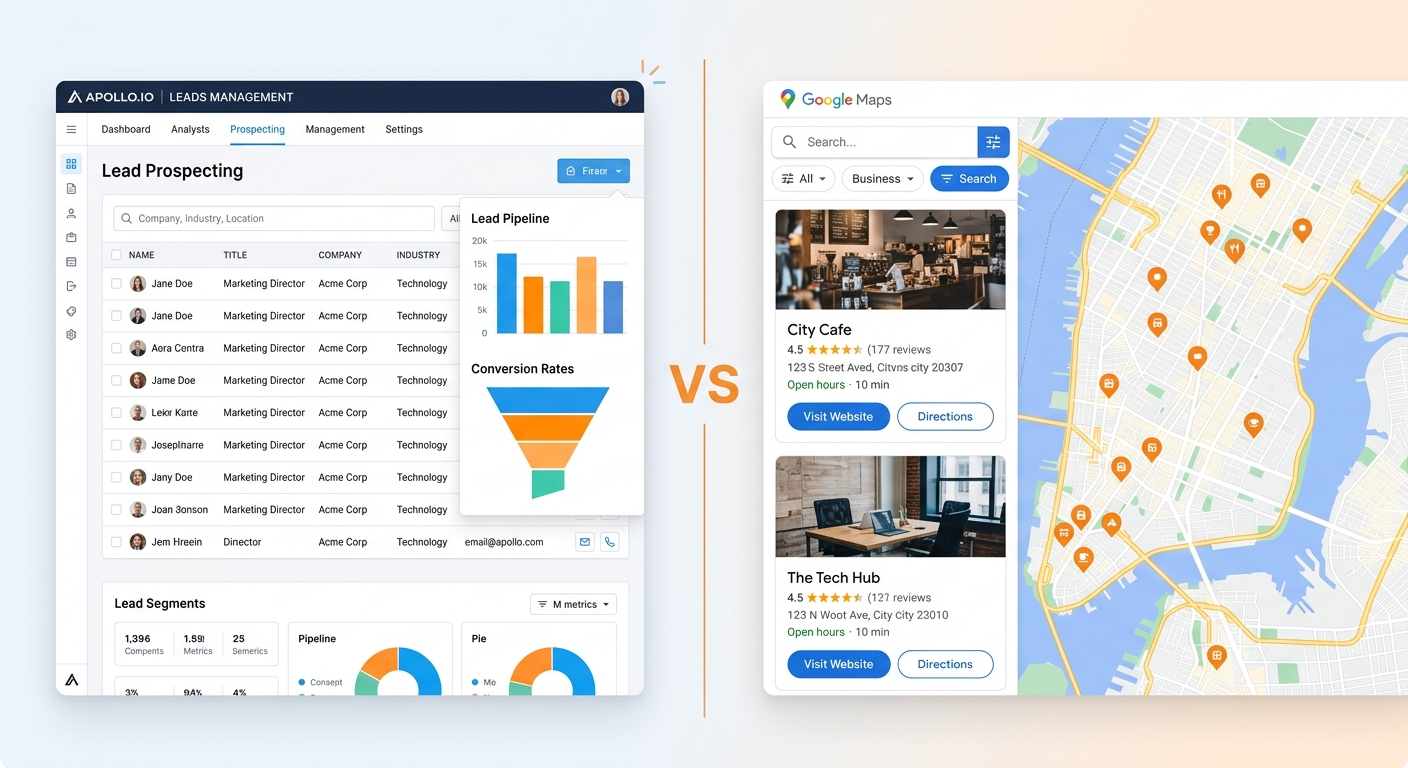
Apollo.io is the default choice for B2B sales teams. It has millions of contacts, firmographic filters, and a polished interface. But when your target market is local businesses — plumbers, dentists, contractors, restaurants — Apollo becomes an expensive way to get mediocre data.
This article compares Google Maps scrapers and Apollo.io head-to-head on the metrics that matter for local lead generation: data quality, contact accuracy, cost per lead, and conversion rates.
The fundamental difference: Database vs. live listings
Apollo.io builds its database by scraping LinkedIn, public records, and user-contributed data. That data is updated periodically, but it is always behind reality. People change jobs, businesses close, and contact information goes stale.
Google Maps is different. Every listing represents a verified, operating business with a physical location. Google actively removes closed businesses and updates listings in real-time. When you scrape Google Maps, you are extracting live data, not a snapshot from six months ago.
This difference shapes everything else about the two approaches.
Data quality comparison
| Data Point | Apollo.io | Google Maps Scraper |
|---|---|---|
| Business verification | Varies; includes closed businesses | Verified operating locations only |
| Email accuracy | 70-80% deliverable on average | 85-95% (extracted from live websites) |
| Phone numbers | Often missing or outdated | Usually current; businesses rely on them |
| Physical address | Sometimes missing | Always present; verified by Google |
| Business category | Industry codes | Specific services (e.g., “emergency plumber”) |
| Review signals | Not available | Rating, review count, claimed status |
| Data freshness | Weeks to months old | Real-time |
For local businesses, Google Maps data is simply richer. You get the exact services a business offers, their actual neighborhood, and signals like review count that indicate how established they are.
Contact accuracy: Where the conversion happens
The biggest factor in cold outreach success is reaching the right person. Here is how the two sources compare.
Apollo.io contacts
Apollo gives you individual employees with job titles. For a local plumbing company, you might get the owner listed as “CEO” or an office manager listed as “Operations.” Sometimes you get neither — just a generic info@ email.
The problem is that local businesses rarely maintain LinkedIn profiles the way enterprises do. A one-person HVAC company might not have any employees listed at all. Apollo’s coverage of small local businesses is thin.
Google Maps scraper contacts
A Google Maps scraper like MapGopher extracts the business itself, then visits the company website to find email addresses. You get addresses like info@, contact@, or the owner’s name directly from their contact page.
These emails convert better for three reasons:
-
They are current. The email came from the website the business maintains today, not a database scraped months ago.
-
They reach decision-makers. Local businesses are small. An email to info@ usually reaches the owner or someone who can make purchasing decisions.
-
They are business-focused. You are not emailing someone’s personal Gmail. You are reaching their business inbox where they expect vendor communications.
In practice, Google Maps-sourced emails see 15-25% higher open rates and significantly lower bounce rates compared to Apollo-sourced contacts for local business campaigns.
Cost per lead: The math that matters
Pricing models tell you a lot about who a tool is built for.
Apollo.io pricing
- Free plan: Limited credits, basic features
- Basic: $59/month per user
- Professional: $99/month per user
- Organization: $149/month per user
At the Professional tier ($99/month), you get unlimited email credits but limited mobile credits and export limits. For a team of three, that is $297 per month before you send a single email.
Google Maps scraper pricing
MapGopher is a $79 one-time purchase. No monthly fee. No per-lead charges. No user limits. You pay once and extract unlimited leads forever.
Cost comparison at scale
| Leads per Month | Apollo.io (3 users) | MapGopher | Savings |
|---|---|---|---|
| 500 | $297/month | $0 | $297/month |
| 2,000 | $297/month | $0 | $297/month |
| 5,000 | $297/month | $0 | $297/month |
| Annual cost | $3,564 | $79 | $3,485 |
The break-even point is immediate. One month of Apollo costs nearly four times the entire lifetime cost of MapGopher.
Conversion rates: Which leads actually close?
Cost per lead only matters if the leads convert. Here is how real campaigns compare.
Apollo.io for local businesses
A typical Apollo campaign targeting local businesses might see:
- 40-50% open rate (lower for local businesses with thin LinkedIn presence)
- 2-3% reply rate
- 10-15% of replies turn into calls
- 1-2% of contacts become customers
The challenge is relevance. Apollo data tells you where someone works, but not what their business needs. Your outreach is generic because you have limited context.
Google Maps scraper for local businesses
Campaigns using Google Maps data typically see:
- 50-65% open rate (higher because emails are current and business-focused)
- 8-15% reply rate (higher because of personalization signals)
- 20-30% of replies turn into calls
- 3-5% of contacts become customers
The difference is the data. When you know a business has an unclaimed Google profile, no website, or only three reviews, you can write emails that speak directly to their situation. That relevance drives replies.
When Apollo.io makes sense
Apollo.io is the better choice when:
- You are targeting mid-market or enterprise companies with 50+ employees
- You need specific job titles (VP of Marketing, Director of Sales)
- You are selling high-ticket B2B software or services
- Your prospects actively maintain LinkedIn profiles
- You need CRM integrations and team collaboration features
Apollo is built for traditional B2B sales. If your ideal customer is a SaaS company or a marketing agency, Apollo delivers.
When a Google Maps scraper makes sense
A Google Maps scraper is the better choice when:
- You are targeting local businesses (plumbers, dentists, contractors, restaurants)
- You need verified phone numbers and physical addresses
- You want to segment by signals like unclaimed profiles or low reviews
- You are a freelancer or small agency with budget constraints
- You need unlimited lead volume without per-seat pricing
Google Maps data is built for local outreach. If your ideal customer is a service business with a physical location, a scraper delivers better data at a fraction of the cost.
Feature comparison
| Feature | Apollo.io | MapGopher |
|---|---|---|
| Pricing model | Monthly subscription per user | One-time purchase |
| Lead limits | Unlimited emails on paid plans | Unlimited |
| Data source | LinkedIn, public records, contributions | Live Google Maps listings |
| Email extraction | Pre-built database | Live website crawling |
| Phone numbers | Limited mobile credits | Unlimited extraction |
| Local business coverage | Thin for small businesses | Comprehensive |
| Intent signals | Buying intent scores | Unclaimed status, reviews, website presence |
| CRM integrations | Extensive | CSV export (import anywhere) |
| Learning curve | Moderate | Minimal |
| Offline access | No | Yes (desktop app) |
Real-world scenario: Agency prospecting
Imagine you run a local SEO agency and need 1,000 leads per month for your outreach campaigns.
Using Apollo.io
You pay $297/month for three Professional seats. You spend hours filtering by industry and company size, but coverage of local businesses is spotty. You get 800 contacts with 60% email coverage. Of those, 20% bounce because the data is stale. You end up with 384 reachable leads.
Your emails are generic because Apollo does not tell you if a business has claimed their Google profile. Reply rates are 3%. You book 12 calls and close 2 deals.
Using MapGopher
You pay $79 once. You run five extractions targeting specific niches and cities. You get 1,200 leads with 70% email coverage. Emails are extracted from live websites, so only 5% bounce. You end up with 798 reachable leads.
You segment by unclaimed profiles and low reviews. Your emails reference specific problems each business has. Reply rates are 12%. You book 48 calls and close 8 deals.
The difference: More leads, better data, higher conversion, and $3,485 less in annual costs.
The verdict
Apollo.io is a powerful tool for traditional B2B sales. If you are selling to marketing directors at tech companies, it is worth the subscription.
For local business lead generation, Google Maps scrapers win on every metric that matters: data quality, contact accuracy, cost per lead, and conversion rates. The live data, intent signals, and one-time pricing make them the clear choice for agencies, freelancers, and sales teams targeting local markets.
If your prospects have physical locations and Google Maps listings, scrape those listings. Do not pay monthly for a database that was never built for local businesses in the first place.
MapGopher extracts live Google Maps data with automatic email discovery for a one-time $79 purchase. No subscription. No per-lead fees. Built for local lead generation.