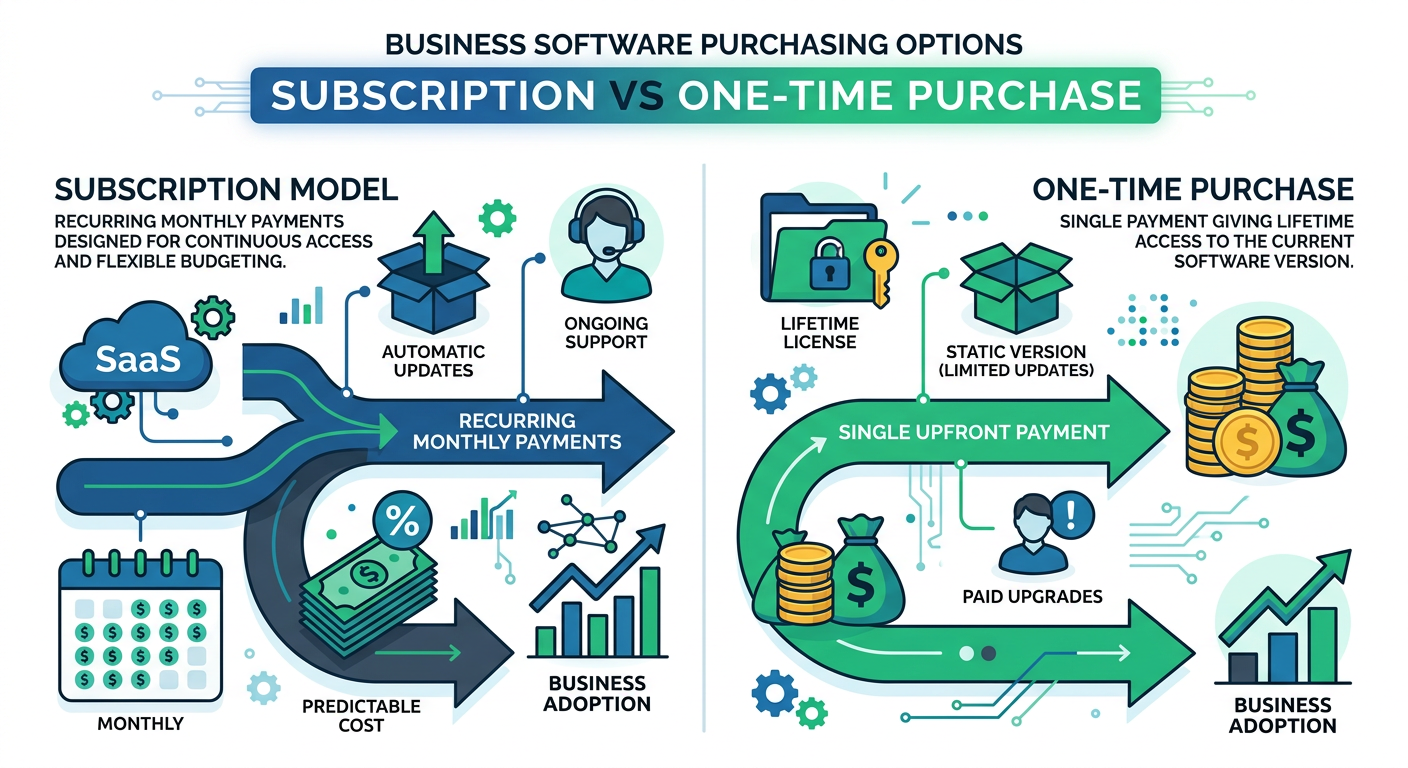
The lead generation software industry runs on subscriptions. Apollo.io, ZoomInfo, Lusha, and dozens of competitors charge monthly fees that scale with your team size. A three-person sales team might pay $300-500 per month before sending a single email.
There is an alternative. One-time purchase Google Maps scrapers offer unlimited lead extraction for a single flat fee. No monthly charges. No per-lead costs. No usage caps.
This article breaks down the economics of both models and shows why the one-time approach wins for local business lead generation.
The subscription trap
Subscription pricing seems reasonable at first. Fifty or ninety-nine dollars per month does not sound like much when you are focused on closing deals.
But subscriptions compound. A tool that costs $99 per month costs $1,188 per year. Over three years, that is $3,564. And that assumes the price never increases, which it usually does.
Real subscription costs over time:
| Tool | Monthly Cost | Year 1 | Year 2 | Year 3 | 3-Year Total |
|---|---|---|---|---|---|
| Apollo Basic | $59/user | $708 | $708 | $708 | $2,124 |
| Apollo Professional | $99/user | $1,188 | $1,188 | $1,188 | $3,564 |
| ZoomInfo Professional | $150/user | $1,800 | $1,800 | $1,800 | $5,400 |
| Lusha Premium | $99/user | $1,188 | $1,188 | $1,188 | $3,564 |
| G Maps Extractor | $39-99/month | $468 | $468 | $468 | $1,404 |
These numbers are per user. A team of three on Apollo Professional pays $3,564 per year. Over three years, that is nearly $11,000 for contact data.
The subscription model works for venture-backed SaaS companies because it produces predictable recurring revenue. It does not work as well for the businesses paying those subscriptions.
The one-time alternative
One-time purchase tools flip the model. You pay once, typically between $50 and $200, and own the software forever.
One-time purchase costs:
| Tool | One-Time Cost | Year 1 | Year 2 | Year 3 | 3-Year Total |
|---|---|---|---|---|---|
| MapGopher | $79 | $79 | $0 | $0 | $79 |
| Botsol Scraper | $30/month* | $360 | $360 | $360 | $1,080 |
| MapsScraper | $190/year* | $190 | $190 | $190 | $570 |
*Note: Botsol and MapsScraper are actually subscription products despite desktop deployment. True one-time purchases are rare.
MapGopher is a true one-time purchase. Pay $79 once and extract unlimited leads forever.
Cost per lead: The metric that matters
Subscription pricing obscures the real cost of lead generation. When you pay monthly, you stop thinking about cost per lead because it feels like a fixed overhead.
But cost per lead is what determines your unit economics. If you pay $99 per month and extract 500 leads, your cost per lead is $0.20. If you extract 5,000 leads, your cost per lead drops to $0.02.
Cost per lead comparison:
| Monthly Volume | Subscription ($99/mo) | MapGopher ($79 one-time) |
|---|---|---|
| 500 leads | $0.20 per lead | $0.16 per lead (month 1), $0 thereafter |
| 1,000 leads | $0.10 per lead | $0.08 per lead (month 1), $0 thereafter |
| 2,000 leads | $0.05 per lead | $0.04 per lead (month 1), $0 thereafter |
| 5,000 leads | $0.02 per lead | $0.016 per lead (month 1), $0 thereafter |
The subscription cost is perpetual. The one-time cost amortizes to zero.
After your first month, every lead you extract with MapGopher is effectively free. After a year, your cost per lead approaches zero. With subscriptions, you pay the same whether you extract one lead or ten thousand.
The break-even analysis
When does a one-time purchase pay for itself compared to a subscription?
Scenario: Solo freelancer extracting 1,000 leads per month
| Tool | Monthly Cost | Break-Even Month | 1-Year Savings | 3-Year Savings |
|---|---|---|---|---|
| Apollo Professional | $99 | Never | $1,109 | $3,485 |
| G Maps Extractor Pro | $39 | Month 3 | $389 | $1,325 |
| MapGopher | $79 one-time | Immediate | $1,109 | $3,485 |
MapGopher breaks even immediately because there are no ongoing costs. Compared to Apollo, you save over $1,100 in year one and over $3,400 over three years.
Scenario: Three-person agency extracting 5,000 leads per month
| Tool | Monthly Cost | Break-Even Month | 1-Year Savings | 3-Year Savings |
|---|---|---|---|---|
| Apollo Professional (3 seats) | $297 | Never | $3,485 | $10,637 |
| MapGopher (3 devices) | $79 one-time | Immediate | $3,485 | $10,637 |
For agencies, the savings are dramatic. One license covers your whole team. Three years of Apollo costs over $10,000. MapGopher costs $79.
Hidden costs of subscriptions
The sticker price is not the only cost. Subscriptions come with hidden expenses that add up over time.
Per-seat pricing
Most subscription tools charge per user. Add a team member, add another monthly fee. One-time tools typically allow installation on multiple devices or have no user restrictions at all.
Credit systems
Some tools advertise “unlimited” leads but limit you with credits. Extract more than your monthly allowance and you pay overage fees or upgrade to a higher tier.
API costs
Cloud-based scrapers often require API keys that have their own usage limits and costs. Exceed the free tier and you are paying per request.
Price increases
Subscription prices tend to rise over time. A tool that costs $99 today might cost $129 next year. One-time purchases lock in your price forever.
Cancellation risk
Stop paying a subscription and you lose access immediately. All your historical data, saved searches, and workflows disappear. With a one-time purchase, you own the tool regardless of future decisions.
Quality comparison: Do you get what you pay for?
A common objection to one-time tools is that they must be lower quality than expensive subscriptions. The data suggests otherwise.
Data freshness
Subscription tools rely on databases that are updated periodically. One-time Google Maps scrapers extract live data from current listings. The one-time tool often produces fresher data.
Email accuracy
MapGopher visits business websites in real-time to extract email addresses. Subscription tools pull from databases that may be months old. Live extraction typically produces higher accuracy.
Coverage
For local businesses, Google Maps has better coverage than any subscription database. Small service businesses rarely maintain LinkedIn profiles or appear in corporate databases. They all have Google Maps listings.
Features
Subscription tools offer CRM integrations, team collaboration, and advanced filtering. One-time tools focus on extraction and export. For many users, CSV export is sufficient — you can import data into any CRM or email tool.
The quality gap, if it exists, favors the one-time tool for local business data.
Who should choose a subscription?
Subscriptions make sense for certain use cases:
- Enterprise sales teams targeting Fortune 500 companies
- Users who need CRM integrations and advanced workflow automation
- Teams requiring collaboration features like shared lists and team analytics
- Companies selling high-ticket B2B products where lead cost is negligible compared to deal size
- Users who prefer cloud-based tools over desktop applications
If you fit these categories, the subscription premium may be justified.
Who should choose a one-time purchase?
One-time purchases are ideal for:
- Freelancers and solopreneurs with limited budgets
- Local SEO and marketing agencies targeting small businesses
- Real estate professionals prospecting specific neighborhoods
- Sales development reps building their own lead lists
- Anyone who values ownership over recurring obligations
- Users who extract leads in batches rather than continuously
If you are targeting local businesses and do not need enterprise features, the one-time model is the clear winner.
The psychology of ownership
There is a psychological benefit to ownership that spreadsheets miss.
When you subscribe to a tool, you are renting. The relationship is temporary and conditional. You must justify the monthly expense continuously. There is pressure to “get your money’s worth” every single month.
When you buy a tool outright, you own it. The relationship is permanent. You can use it daily or take a month off without guilt. There is no ongoing expense to justify.
This changes how you use the tool. Subscription users tend to ration their usage to minimize costs. Owners use the tool whenever it makes sense for their business, without mental accounting overhead.
Real user scenarios
Scenario 1: The freelance web designer
Sarah builds websites for local businesses. She needs 50-100 new leads per month for her cold outreach. She tried Apollo at $99 per month but found coverage of small local businesses was poor.
She switched to MapGopher for $79 one-time. Now she extracts targeted lists of businesses without websites, pays nothing per month, and gets better data for her niche. She saves $1,100 per year.
Scenario 2: The local SEO agency
Mark’s agency manages Google Business Profiles for 20 clients. Each client needs fresh leads monthly for their own prospecting. With Apollo, he would need three seats at $297 per month.
He uses MapGopher instead. One license covers his whole team. They run unlimited extractions across all client accounts. Annual savings: $3,485.
Scenario 3: The real estate investor
Jennifer buys distressed properties. She targets specific neighborhoods, extracting lists of property owners and local contractors. Her usage is sporadic — heavy one month, light the next.
A subscription would waste money during light months. With MapGopher, she pays once and extracts whenever she needs data. No monthly minimums, no wasted spend.
The lifetime value calculation
Let us project the lifetime cost of lead generation over five years.
Assumptions:
- Extracting 1,000 leads per month
- Apollo Professional at $99/month
- MapGopher at $79 one-time
| Year | Apollo Cost | MapGopher Cost | Cumulative Savings |
|---|---|---|---|
| 1 | $1,188 | $79 | $1,109 |
| 2 | $1,188 | $0 | $2,297 |
| 3 | $1,188 | $0 | $3,485 |
| 4 | $1,188 | $0 | $4,673 |
| 5 | $1,188 | $0 | $5,861 |
Over five years, the one-time purchase saves nearly $6,000. That is enough to hire a virtual assistant, run paid ads, or invest in other growth channels.
Addressing the risks
One-time purchases have potential downsides. Here is how to think about them.
Risk: No ongoing support
Some one-time tools abandon development after launch. Look for tools with recent updates and active user communities. MapGopher provides support to all customers regardless of purchase date.
Risk: No new features
Subscription tools evolve continuously. One-time tools may stagnate. Evaluate whether the current feature set meets your needs. For Google Maps scraping, the core functionality is stable — extraction, email finding, and CSV export.
Risk: Platform changes
If Google changes Maps significantly, scrapers may need updates. This risk applies equally to subscription and one-time tools. Both depend on the same underlying extraction technology.
Bottom line
The subscription model has dominated software for a decade, but it is not the only option. For Google Maps lead generation, one-time purchase tools deliver equal or better data at a fraction of the lifetime cost.
If you are a freelancer, agency, or sales professional targeting local businesses, the math is clear. A $79 one-time purchase beats a $99 monthly subscription every time.
The question is not whether you can afford a one-time tool. It is whether you can afford to keep paying subscriptions forever.
MapGopher offers unlimited Google Maps lead extraction for a one-time $79 purchase. No monthly fees. No per-lead charges. No subscription trap. Just clean, targeted local business data whenever you need it.